
Split Rail Fence Installation in Palm Beach County, FL
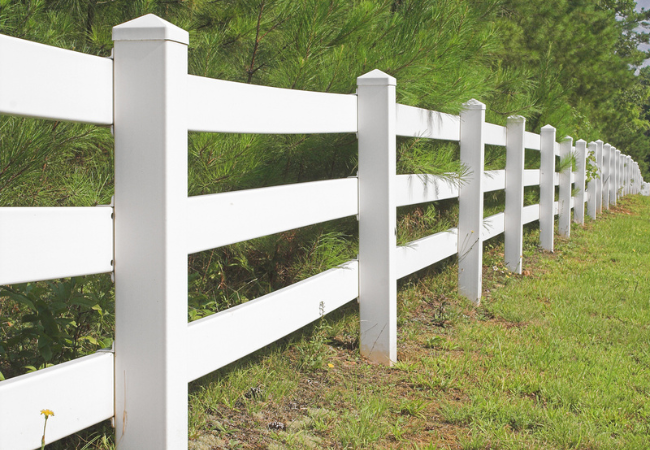
Split rail fencing has a character that no other fence style replicates. The irregular, hand-hewn look of rails split lengthwise from logs gives a property an authenticity that milled lumber and manufactured materials simply cannot match. It is the fence style of working farms, horse properties, and estate entrances — and Pick-It Fence Company has been installing it throughout Palm Beach County since 1990.
We install split rail fencing for residential properties, equestrian operations, agricultural parcels, and acreage lots throughout Palm Beach County. We carry cedar, pressure-treated pine, and vinyl split rail options, and we help every customer understand the honest tradeoffs between them for South Florida’s specific climate before anything is ordered or installed.
Schedule your free split rail fence estimate today.
We visit your property, walk the perimeter, and give you a written quote — no obligation.
Split Rail Fence in Palm Beach County | What It’s Used For
A split rail fence is built from rails that are split lengthwise from logs rather than milled into smooth, uniform lumber. The result is a rail with a naturally irregular, slightly rough profile that reads as genuinely rustic in a way that round rail — which is milled smooth — does not. The posts and rails are typically fitted together using pre-bored holes rather than hardware, which contributes to the clean, traditional look.
In Palm Beach County, split rail is most commonly installed in the agricultural and equestrian communities of the county’s western areas — Loxahatchee Groves, Westlake, Wellington, and Belle Glade — where properties have the acreage and the character to suit it. It is also popular for property entrance framing throughout the county, where two or three rails running along a driveway or road frontage set a rural or estate tone immediately.
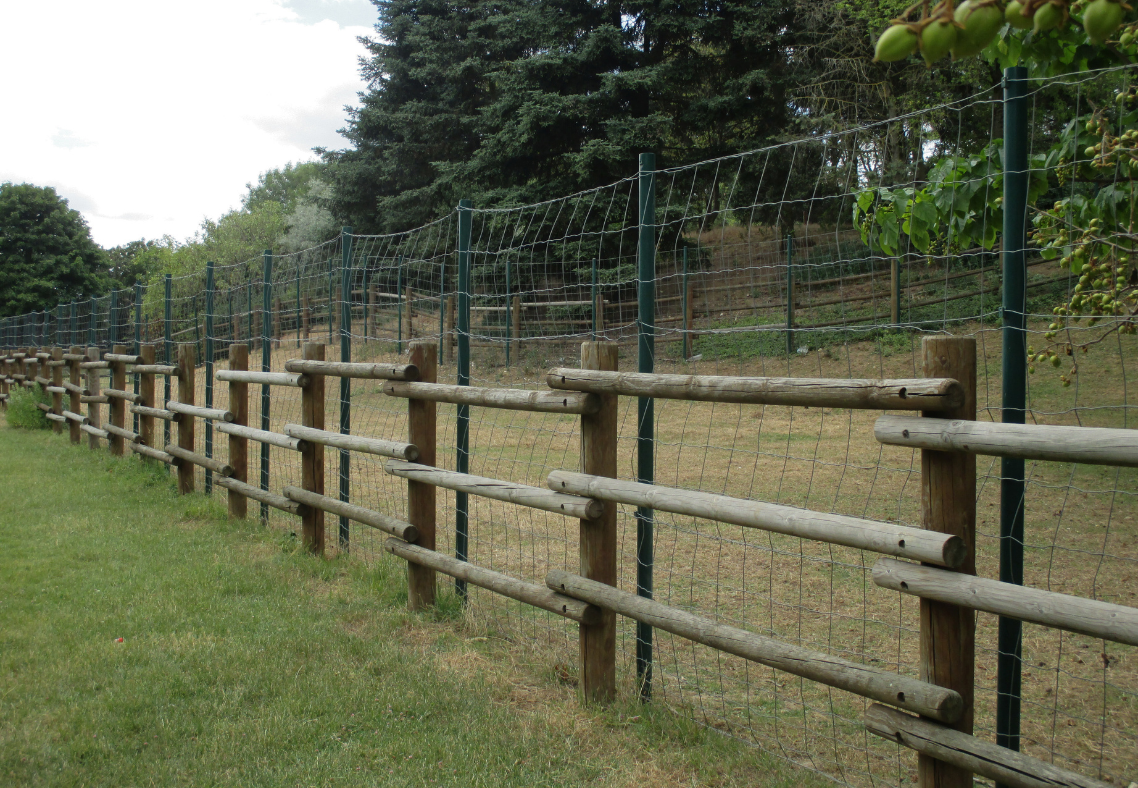
Split rail is an open fence style — it defines a boundary clearly but does not screen, block views, or contain small animals without modification. If containment of small dogs or pool barrier compliance is the goal, wire mesh can be added to a split rail system. If maximum containment is the primary objective, round rail with more rails or post-and-board construction may be a better starting point.
Split Rail vs Round Rail. Which One Is Right For Your Property?
Pick-It installs both split rail and round rail fencing. Split rail uses logs split lengthwise — giving a rougher, more rustic, historically authentic character. Round rail uses milled cylindrical rails — cleaner, more uniform, and available in vinyl and composite as well as wood. If you are deciding between the two, see our Round Rail Fence page or our blog post ‘The Difference Between Round Rail and Split Rail Fences’ for a direct comparison. We are happy to discuss both during your estimate.
Split Rail Fence Options We Install
We install split rail fencing in the configurations and materials that make sense for Palm Beach County properties. Every installation is discussed and specified during the free on-site estimate.

2-Rail Split Rail
Two horizontal rails between posts. The simplest configuration is clean, open, and well suited to property frontage, entrance framing, and decorative boundary applications.
3-Rail Split Rail
Three rails for a more substantial boundary. The most common choice for larger agricultural lots and equestrian perimeters where the fence needs to be clearly visible and physically present.
Zigzag / Buck-and-Rail
A traditional American fence style where rails are stacked in an alternating zigzag pattern without posts. Highly rustic character, no digging required. Best for decorative applications on flat to gently sloped ground.
Cedar Split Rail
Cedar is naturally rot-resistant and handles South Florida’s humidity better than most wood species without chemical treatment. It weathers to a silvery grey over time. Higher upfront cost than treated pine with lower maintenance requirements.
Pressure-Treated Pine
The most widely installed split rail material in Palm Beach County. Treated pine is affordable, widely available, and durable when properly rated for ground contact. The standard choice for working farms and functional perimeters.
Vinyl Split Rail
A split-rail profile manufactured in vinyl — zero-maintenance, does not rot or splinter, and holds its color without staining or treatment. Less common than wood split rail but increasingly requested by property owners who want the look without the upkeep.
Wire Mesh Addition
Hardware cloth or no-climb welded wire attached to the inside face of a split rail system to contain small animals, meet pool barrier requirements, or deter wildlife. Can be added during installation or retrofitted to an existing fence.
Gates
Matching split rail swing gates in single and double configurations for driveway and property access openings. Properly framed to handle gate weight and daily use without sagging.
Custom Rail Counts & Heights
Non-standard rail counts, closer post spacing, custom heights, and corner configurations designed around the layout and intended use of your specific property.
Cedar vs Treated Pine vs Vinyl in South Florida’s Climate
Material selection matters more in South Florida than in almost any other region. The combination of heat, humidity, heavy seasonal rain, and UV intensity is demanding on exterior wood. Here is an honest breakdown of how each split rail material performs here:
Cedar Split Rail
Cedar contains natural oils that resist moisture, insects, and fungal decay without chemical treatment. In South Florida’s climate, cedar outperforms untreated pine significantly and requires less intervention over time than treated pine as well. It weathers to a natural silvery grey when left untreated — a look that suits rural and estate properties well. The tradeoff is cost: cedar split rail is more expensive upfront than treated pine. For property owners who want a long-lived, naturally beautiful fence with minimal maintenance, cedar is the right answer.
Pressure-Treated Pine
Pressure-treated pine is the workhorse of split rail fencing in Palm Beach County. It is more affordable than cedar, widely available, and — when properly rated for ground contact — performs well in South Florida’s conditions for 15 to 20 years or more. The key qualifier is ‘properly rated for ground contact’: not all treated lumber is created equal, and posts set in the ground require a higher treatment level than above-ground components. We specify the correct treatment rating for every installation. Treated pine can be stained or painted, though most customers in agricultural settings leave it natural.
Vinyl Split Rail
Vinyl split rail is manufactured to replicate the profile and appearance of natural split rail while eliminating maintenance entirely. It does not rot, does not splinter, does not require staining or treatment, and holds its appearance without intervention in South Florida’s sun and humidity. For large-acreage properties where treating or replacing wood rails across significant linear footage would be an ongoing commitment, vinyl’s long-term economics are compelling. The tradeoff is that vinyl does not have the natural character and texture of real split wood — and for customers who specifically want an authentic, traditional aesthetic, that matters.
Our Split Rail Fence Installation Process
Every split rail fence we install follows the same structured process regardless of the size of the property or the number of rails involved.

Free On-Site Estimate
We visit your property, walk the perimeter or the section you want fenced, assess soil and grade conditions, and discuss the configuration, material, and intended use. For agricultural and equestrian properties, we spend more time on the site visit — the details matter more on larger jobs.
Material & Configuration Selection
We finalize the rail count, post spacing, wood species or vinyl profile, and any gate or wire mesh requirements. You receive a written quote before any materials are ordered or work begins.
Permit Assessment
Split rail fencing on properties with an agricultural classification in unincorporated Palm Beach County may be exempt from standard building permit requirements. We assess this for every job and handle any required permits. You do not need to research the exemption rules yourself.
Post Setting
Posts are set in concrete at the correct depth for the fence height and the soil conditions of your specific property. Sandy flatwoods soil in western Palm Beach County requires careful attention to post depth and concrete anchoring — posts that are not properly set in this soil type will lean and shift over time.
Rail Installation
Rails are fitted into the pre-bored holes in the posts in sequence. We check alignment throughout the installation to ensure the fence runs true. For zigzag and buck-and-rail configurations, we lay out the pattern before setting any posts to make sure the geometry works with the property's boundaries.
Wire Mesh & Gate Installation
Where wire mesh is included, it is attached to the inside face of the fence after rail installation and secured at the base to prevent burrowing. Gates are hung, adjusted, and tested for proper latching before we consider the job complete.
Gate Installation & Walkthrough
Gates are installed and adjusted for proper operation. We walk the completed fence with you before we consider the job finished.
Final Walkthrough
We walk the completed installation with you. Every post, every rail, every gate latch. If anything is not right, we address it before we leave.
Why Palm Beach County Property Owners Choose Pick-It Fence
Pick-It Fence Company is a family-owned fencing contractor based in Loxahatchee — part of the same agricultural and rural community where much of our split rail fence work is done. We have been installing fencing throughout Palm Beach County since 1990 and bring 35 years of direct local experience to every property we work on.
- Over 10,000 fence installations completed across Palm Beach County
- Licensed, insured, and bonded — credentials available on request
- We pull all required permits — you never deal with the permitting office
- HOA approval applications prepared and submitted on your behalf
- Warranty on both labor and materials supplied
- Free on-site estimates with written quotes — no obligation
- Serving residential and commercial clients throughout the county
We Stand Behind Every Fence We Build
Every split rail fence we install is covered by our warranty on both labor and the materials we supply. If something fails as a result of our workmanship or a materials defect, we come back and make it right. Ask your estimator for full warranty terms during your on-site visit.
Common Questions About Split Rail Fencing in Palm Beach County
What is the difference between split rail and round rail fencing?
Split rail uses rails that are literally split lengthwise from logs, giving an irregular, rough-hewn profile with natural character. Round rail uses milled cylindrical rails — smooth, uniform, and available in vinyl and composite as well as wood. Both are post-and-rail fence styles, but split rail reads as more rustic and traditionally authentic, while round rail looks cleaner and more finished. Pick-It installs both. See our blog post ‘The Difference Between Round Rail and Split Rail Fences’ for a full comparison, or ask us during your estimate.
Which wood is best for split rail fencing in South Florida — cedar or treated pine?
Both work well when properly specified. Cedar is naturally rot-resistant and requires less maintenance than treated pine over time — it is the better long-term choice for customers who want to minimize upkeep. Treated pine is more affordable upfront and performs well when rated correctly for ground contact, which we always verify. For most working farm and agricultural applications, treated pine is the practical standard. For estate entrances and decorative applications where long-term appearance matters more than upfront cost, cedar is worth considering.
Can split rail fence be used to contain dogs or meet pool barrier requirements?
Not without modification. A standard split rail fence has wide openings between rails that most dogs can pass through and that do not meet Florida’s pool barrier code. Wire mesh — hardware cloth or no-climb welded wire — can be attached to the inside face of the fence to address both issues. We install wire mesh as part of the original installation or can add it to an existing split rail fence. Pool barrier compliance requires specific height minimums and self-closing, self-latching gate hardware, which we specify and install to code.
Do I need a permit for split rail fencing in Palm Beach County?
It depends on your property’s zoning and land use classification. Agricultural properties in unincorporated Palm Beach County may be exempt from standard fence permit requirements. Residential properties and incorporated municipalities generally require permits. We assess the permit situation for every job during the estimate and handle all required applications — you do not need to navigate the process yourself.
How tall is a split rail fence typically?
Standard split rail fence heights in Palm Beach County are three to four feet, which is appropriate for most decorative boundary and property definition applications. Two-rail fences typically run around three feet; three-rail fences run closer to four feet. For equestrian applications, a three- or four-rail configuration with a higher top rail may be more appropriate. We discuss height and configuration for your specific use during the estimate.
How long does a cedar split rail fence last in South Florida?
A cedar split rail fence in Palm Beach County typically lasts 20 to 30 years when posts are properly set and the fence is maintained with occasional cleaning. Cedar’s natural oils resist the rot and insect activity that South Florida’s humidity accelerates in untreated wood. The posts — which are in contact with the soil — are the most vulnerable component; proper depth and concrete setting extends their life significantly.
Can split rail fencing handle a slop or uneven terrain?
Yes. Split rail fencing accommodates grade changes through a racking method where the rails follow the slope of the ground, or through stepping where each panel drops at set intervals. For zigzag and buck-and-rail configurations, the geometry needs to be planned around the grade before any posts are set. We assess the grade during the site visit and recommend the appropriate installation method.
Is split rail fence more affordable than other fence styles?
Generally yes for large acreage applications. Split rail uses fewer materials and less labor per linear foot than privacy fence, solid board fence, or ornamental aluminum — which makes it a cost-effective option for enclosing significant property areas where screening is not required. For smaller decorative applications, the cost advantage is less pronounced. We provide a written quote based on your specific property during the estimate.
Get Your Free Split Rail Fence Estimate
Call us or submit a request online. We’ll visit your property and give you a written quote — typically within 48 hours.